By TESFA-ALEM TEKLE
Eritrea’s armed opposition group, the Red Sea Afar Democratic Organization (RSADO) has expressed deep concern over what it describes as ongoing and systematic human rights violations against the Afar people in Eritrea.
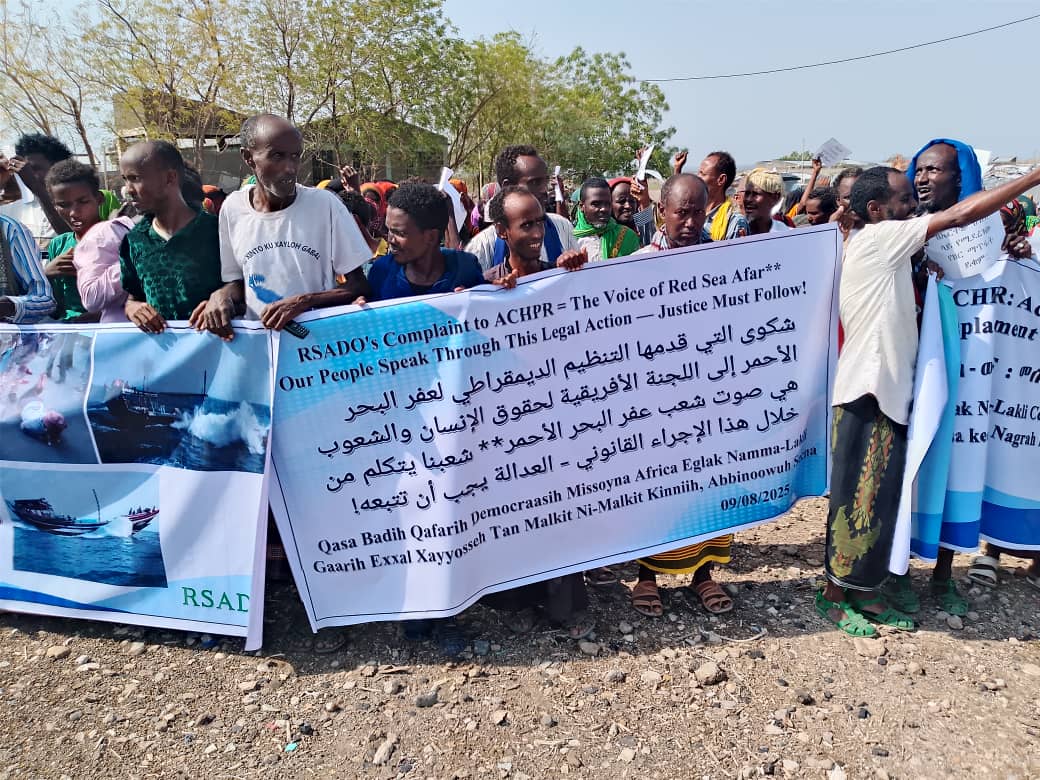
In a press statement it sent to The East African Daily, the organization on Friday acknowledged the attention given by the African Commission on Human and Peoples’ Rights to its submitted complaint, which highlights alleged patterns of ethnic persecution in the Red Sea region.
According to the organization, since Eritrea’s independence in 1993, the Afar population has been subjected to sustained policies that undermine their fundamental rights.
These measures reportedly include restrictions on traditional economic activities, particularly fishing and maritime trade sectors that have historically formed the backbone of Afar livelihoods.
The statement further alleges that Afar communities have faced repeated forced evictions from their ancestral lands, including villages and coastal territories stretching from Massawa to Ras Dumer.
This displacement, covering more than 700 kilometers, is described as having caused widespread economic hardship and social disruption, affecting hundreds of thousands of civilians.
The Eritrean government has consistently denied accusations of ethnic persecution. However, the organization maintains that documented evidence, testimonies, and field reports point to a systematic campaign targeting the Afar population, threatening their cultural identity and economic survival.
Among the most serious concerns raised is the restriction on access to marine resources, which has significantly impacted the Afar’s traditional way of life.
Additional allegations include enforced conscription, arbitrary detention, extrajudicial killings, and the creation of an environment of fear, leading to displacement both within Eritrea and across borders into neighboring countries such as Djibouti, Ethiopia, and Yemen.
The organization also claims that Afar communities face discrimination in access to basic services, including education, healthcare, and development opportunities, as well as limitations on full citizenship rights.
These conditions, it argues, have contributed to long-standing marginalization.
In response to recent remarks by Eritrea’s Foreign Minister at the Geneva Conference held on April 9–10, 2026, which attributed human rights challenges to external sanctions, the organization rejected this position as selective and inconsistent with realities on the ground.
It further stated that such narratives overlook documented internal violations affecting both the broader population and the Afar community in particular.
The Red Sea Afar Democratic Organization has called on international and regional actors to take urgent steps, including increased pressure on the Eritrean government to end alleged abuses.
It also urged support for the Afar people’s demands for fundamental rights, the establishment of an independent international investigation, and the guarantee of equal citizenship without discrimination.
Additional recommendations include the immediate cessation of forced displacement, arbitrary detention, and forced conscription, as well as ensuring unrestricted access to humanitarian assistance in affected areas.
The organization further called for sustained monitoring by United Nations human rights mechanisms.
In conclusion, the statement underscores the need for greater international attention to the situation of the Afar people and calls for accountability regarding alleged violations, emphasizing that the protection of fundamental human rights remains an urgent priority