By Rogers Tulyahabwe
Amakwerekwere is the word many black South Africans say when they mean an African migrant. It is an onomatopoeic slur, said to mimic the unfamiliar sound of other African languages to Zulu or Xhosa ears, and it points to a very specific category of outsider. What South Africa is living through in 2026 is not a broad allergy to outsiders but a hierarchy of who gets to belong to Africa and who does not, enforced by South Africans against fellow Africans.
From a policy perspective, South Africa spent two decades letting its own immigration department become a marketplace. Now it is watching township vigilantes do, badly and violently, the job that department failed to do at all. Vigilantism did not invent this crisis, it exploited a governance failure that was already years in the making.
The sentiment behind those marches has a documented lineage. The Human Sciences Research Council’s investigation into the May 2008 riots, which began in Alexandra and killed 62 people, including Mozambican national Ernesto Alfabeto Nhamuave, who was beaten, stabbed and burned alive while bystanders photographed the flames, identified four specific drivers: relative deprivation and competition for scarce jobs and housing, group psychology built on national rather than shared identity, what researchers called South African exceptionalism, a sense of superiority toward the rest of the continent, and an exclusionary form of citizenship that draws boundaries tightly around who counts as belonging.
A parallel study commissioned by the International Organization for Migration reached a similar conclusion: poor service delivery and the presence of foreign nationals were contributing factors, but township politics and organised mobilisation did the actual work of turning grievance into a riot. Scholars researching apartheid’s legacy have since argued that this pattern draws on something older still, a system that normalised violence as the language of political grievance and, at the same time, isolated black South Africans from the rest of Africa for generations, producing exactly the unfamiliarity with fellow Africans that the 2008 report described.
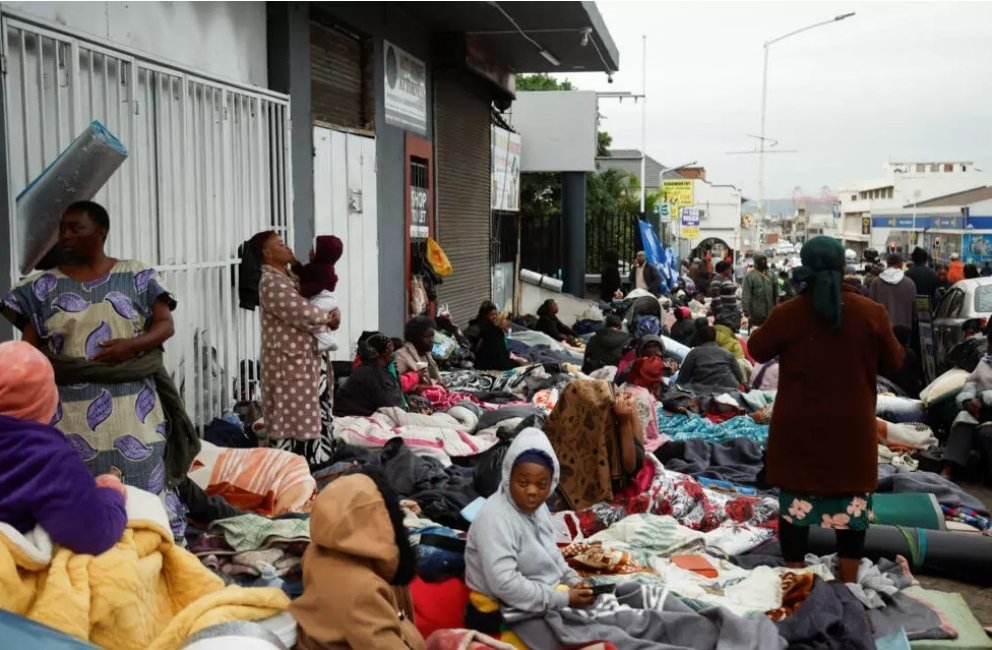
The 2026 wave repeats that pattern with better organisation and a fixed deadline. Operation Dudula and the newer movement March and March, led by Jacinta Ngobese-Zuma, popularised 30 June as the date by which undocumented migrants were expected to leave the country, a deadline with no legal standing that the government itself repeatedly disowned. More than 900 people were arrested across 120 marches on that date.
Roughly 25,000 foreign nationals are said to have left the country in the surrounding weeks, some bussed home by their own governments from outside Home Affairs offices and embassies.
A couple of people have been killed since the mobilisation began in April, among them a Malawian man beaten to death in Pietermaritzburg after public incitement linked to anti-migrant activism. President Cyril Ramaphosa addressed the nation on 7 June, acknowledged the protesters’ underlying grievances, and committed 600 million rand to a security operation rather than to the asylum and permitting system whose backlog helped produce the unrest in the first place.
That system’s condition is not in dispute. A Special Investigating Unit inquiry, authorised by Ramaphosa himself, found that Home Affairs had functioned for two decades, from 2004 to 2024, as a marketplace in which visas, permits and identity documents were sold to the highest bidder, implicating figures including the fugitive preacher Shepherd Bushiri, businessman Kudakwashe Mpofu and Nigerian musician Prince Daniel Obioma. Home Affairs Minister Leon Schreiber described the department’s condition since as one of syndicatisation, borders and permits ran as just another sector where value could be extracted through corruption.
The Border Management Authority’s own figure, that it intercepted more than 450,000 people attempting to enter the country illegally in the past financial year, is offered by government as evidence of vigilance, but it just as easily reads as evidence of how much pressure a porous, poorly resourced border is under regardless of enforcement volume. None of this is new information forced on the state by the current unrest. It is two years of published investigation that predates the marches and that the state had not acted on before the marches began.
It is also worth stating plainly what the data says about the economic claim driving the anger, because the claim does not hold up well under scrutiny.
The International Organization for Migration’s World Migration Report 2026 counted around 304 million international migrants worldwide by mid-2024, 3.7% of the global population, sending an estimated $905 billion in remittances, of which $685 billion went to low and middle income countries.
Within Africa specifically, the report counted 45.8 million African-born international migrants, of whom 25 million were living in another African country as of 2024, a figure up 17 per cent from 2020 and nearly 39 per cent from 2015, reflecting both conflict displacement and the gradual expansion of continental free movement arrangements.
South Africa’s migrant population, put at around 2.4 million people or roughly 3.9 per cent of the national population by Statistics South Africa, sits inside that continental pattern.
Domestic research reinforces the same picture. Tax data analysed by researchers at Wits University’s Southern Centre for Inequality Studies found that foreign nationals hold less than 4 per cent of formal jobs in South Africa, a share that has barely moved in a decade, while accounting for a larger but still modest 20 per cent of participants in the informal economy.
A World Bank study on mixed migration and job outcomes in South Africa found that each migrant worker in its sample was associated with roughly two additional jobs for South Africans, a multiplier effect the authors attribute to migrants’ higher rate of small business formation. IOM’s own study of Johannesburg’s informal settlements and inner-city neighbourhoods, the same Hillbrow, Yeoville and Diepsloot areas where recent marches have concentrated, found that migrant-owned informal businesses contribute measurably to local GDP, job creation and supply chains rather than displacing them.
What the data cannot explain is who, specifically, the anger has been aimed at, and that pattern is its own argument. The mobs of 2026 have not marched on the European retirees of Cape Town’s northern suburbs or the Chinese wholesalers running Johannesburg’s industrial parks the same way they have for Malawians, Mozambicans, Zimbabweans, Ethiopians, Nigerians among others.
The insult carried through decades of township slang for African migrants, amakwerekwere, has no equivalent aimed at other foreign nationals living in the same cities.
I do not say this because they should be targeted but to show that this is Afrophobia rather than a general suspicion of outsiders, a racialised hostility that scholars researching the phenomenon trace directly to apartheid’s own architecture, a system that isolated black South Africans from the rest of the continent for generations while selectively importing controlled black labour from the same neighbouring states now supplying the people being hunted. Zambia, Tanzania, Mozambique and Zimbabwe hosted the African National Congress in exile through the worst years of apartheid.
That history sits uncomfortably beside a movement chanting for their citizens to leave. It is however worth adding, in fairness, that South Africa is not alone in this failure. Nigeria expelled foreign nationals in 1983, and Ghana expelled an estimated 1.5 million West African migrants under President Kofi Busia in 1969.
Afrophobia is a continental inheritance, not a uniquely South African disease, which makes its recurrence in the country most identified with Pan-African liberation solidarity harder to excuse.
There is a wider question underneath all of this that South Africa is not the only country avoiding.
The Organisation of African Unity was founded in 1963 on the premise that the borders colonial powers drew at the Berlin Conference were arbitrary lines that should never be allowed to fracture a shared continental future, and the African Union’s own Agenda 2063 still promises a single African passport and unrestricted movement for African citizens across the continent.
Sixty years on, that promise remains mostly aspirational, and nowhere is the gap between the promise and the practice more visible than in a country whose liberation was underwritten by the same neighbouring states it is now expelling. Pan-Africanism was never meant to be a slogan reserved for solidarity conferences and stop at the first town that feels the pressure of its own government’s failures. If African identity means anything beyond a passport issued by an accident of colonial cartography, it has to survive contact with unemployment and a broken visa system.
South Africans do not need a new philosophy to get this right. They need to hold their own government to account but also to the liberation-era promise, and stop forcing other Africans to absorb the failures of their government.
The writer is a Safe Migration and anti-human trafficking advocate. He is reachable at Email: rtulyahabwe@gmail.com