By Aaron Kaviiri Ateenyi
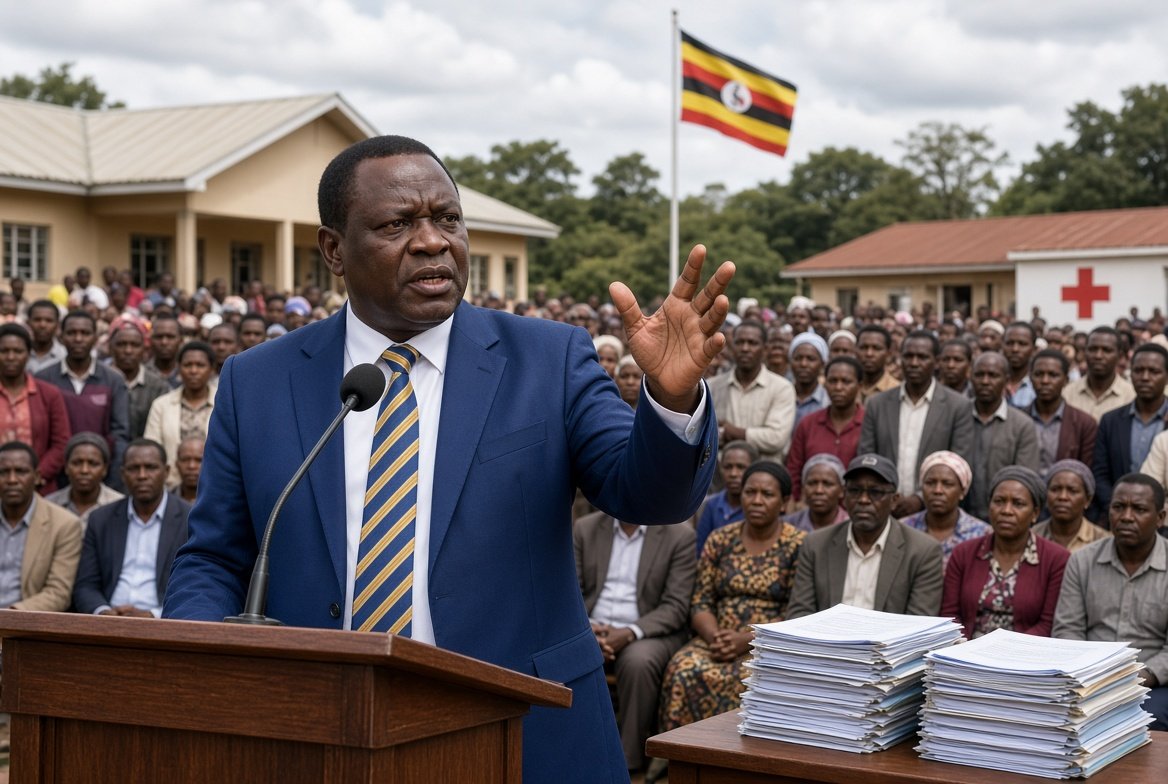
The ongoing Expose the Corrupt campaigns [barazas] led by the Cabinet Minister for Local Government, Balaam Barugahara Ateenyi, have brought to light serious concerns about misuse of government resources, poor supervision, lack of monitoring, and failure to ensure that government programmes benefit ordinary Ugandans.
But beyond exposing these challenges, the campaigns have also raised an even bigger, systemic question: What exactly are our local and regional leaders doing to justify the positions they hold and the salaries they earn from taxpayers’ money?
Under Uganda’s decentralization framework anchored in Chapter Eleven of the 1995 Constitution and operationalized through the Local Governments Act; substantial administrative authority and billions of shillings in fiscal transfers were deliberately devolved to districts so that services could be monitored right at the grassroots.
The country has District Chairpersons (LCVs), Resident District Commissioners (RDCs), Chief Administrative Officers (CAOs), District Internal Security Officers (DISOs), District Service Commissions, technical officers, local government officials, and sub-county administrators whose statutory responsibilities include supervising government projects, monitoring government programmes, inspecting public facilities, and ensuring that services reach the intended ordinary Ugandans.
Yet when things go wrong, projects stall, resources are mismanaged with impunity, and communities are left suffering, where are these leaders and what are they paid for? Who holds them accountable when successive reports from the Office of the Auditor General (OAG) and the Inspectorate of Government (IGG) repeatedly flag billions of shillings lost to inflated procurement, uncompleted works, and payroll fraud without a single local official taking responsibility?
It is no longer enough to occupy air-conditioned offices, attend endless workshops, fuel government double-cabin pickups at the taxpayers’ expense, and collect sitting allowances and monthly salaries. True leadership must be demonstrated through visible action, unwavering commitment, and measurable results on the ground.
A Cabinet Minister should not have to travel hundreds of kilometres from Kampala to a district to discover that there are ghost pupils and students inflating enrolment numbers in Universal Primary and Secondary Education (UPE/USE) schools just to siphon off capitation grants while real learners sit on dusty floors without desks or textbooks.
A Minister should not have to hold a public baraza to uncover that ordinary Ugandans are being brazenly extorted by Local Council (LC) leaders and SACCO executives before they can access Parish Development Model (PDM) funds, a flagship programme meant to lift the 39% of Ugandan households trapped in the subsistence economy into the money economy, where every beneficiary is legally entitled to receive their full UGX 1 million without deductions or kickbacks.
A Minister should not have to storm a district to realize that gazetted government lands meant for public schools, health centres, forestry reserves, and community markets have been illegally surveyed, titled, and encroached upon by well-connected individuals right under the watchful eyes of District Land Boards and physical planners.
A Minister should not have to walk into a public health facility to find that a hospital standby generator has been non-functional or un-fuelled for months while mothers give birth in darkness, that essential medicines marked “Government of Uganda – Not For Sale” mysteriously vanish from public stores only to resurface in nearby private clinics, that salaried health workers abandon their duty stations without consequence, or that ghost workers continue to drain the district wage bill while thousands of qualified young Ugandans remain unemployed.
Uncovering, halting, and punishing these abuses should entirely be the routine, everyday responsibility of our local leaders. Monitoring and supervision must be part of their daily operational culture, not cosmetic, last-minute fire-fighting exercises staged only when senior officials or ministers announce an upcoming visit.
The ordinary Ugandan does not care about eloquent speeches, glossy five-year District Development Plans, or endless government announcements if the promised services never reach their village.
What Ugandans want is straightforward, non-negotiable, and constitutionally guaranteed: functioning health centres stocked with essential medicines, motorable feeder roads that connect rural farmers to markets, well-equipped schools with present and motivated teachers, clean and safe water within walking distance, and wealth-creation programmes that genuinely transform their household livelihoods.
Hon. Balaam’s barazas have therefore pierced a long-standing culture of silence and opened an urgent national conversation about performance accountability.
Grand corruption and outright embezzlement must be confronted with the full force of the law, yes but so must administrative negligence, bureaucratic complacency, and the deliberate abdication of duties attached to public office. When an accounting officer, district engineer, or political head signs off on shoddy roadworks or a crumbling classroom block, that silence is active complicity.
It definitely makes no sense for Government to continue paying fat salaries, pensions, gratuity, and operational allowances to officeholders while the core responsibilities attached to those positions remain unattended. In the private sector, failure to supervise or deliver results leads to immediate dismissal; public service cannot continue to operate as a protected sanctuary for incompetence, laziness, and indifference.
Perhaps it is time citizens across every sub-county and district put our local and regional leaders on notice and asked them some honest, hard, and unavoidable questions: What are you actually doing in those offices from Monday to Friday? Which specific government projects are you supervising with verifiable inspection reports? What anomalies have you personally uncovered and corrected through your own monitoring before a Minister stepped foot in your district? And what concrete, measurable difference has your leadership made in the lives of the ordinary Ugandans whose taxes pay your salary?
From these campaigns, one undeniable truth stands out with crystal clarity: Uganda does not lack leaders, policies, laws, or well-funded government programmes.
What badly lacks and what citizens urgently demand is leadership that cares, takes personal ownership, enforces standards without fear or favour, and delivers tangible results to ordinary Ugandans.
Uganda’s local and regional leaders need to wake up to a new reality: Public office is not a personal privilege to enjoy, nor a comfort zone for the complacent; it is a sacred constitutional responsibility to serve. Every single shilling paid by the Ugandan taxpayer must come with strict accountability, integrity, and undeniable work on the ground.