By: Dr Yonas Workineh (source: Agencies)
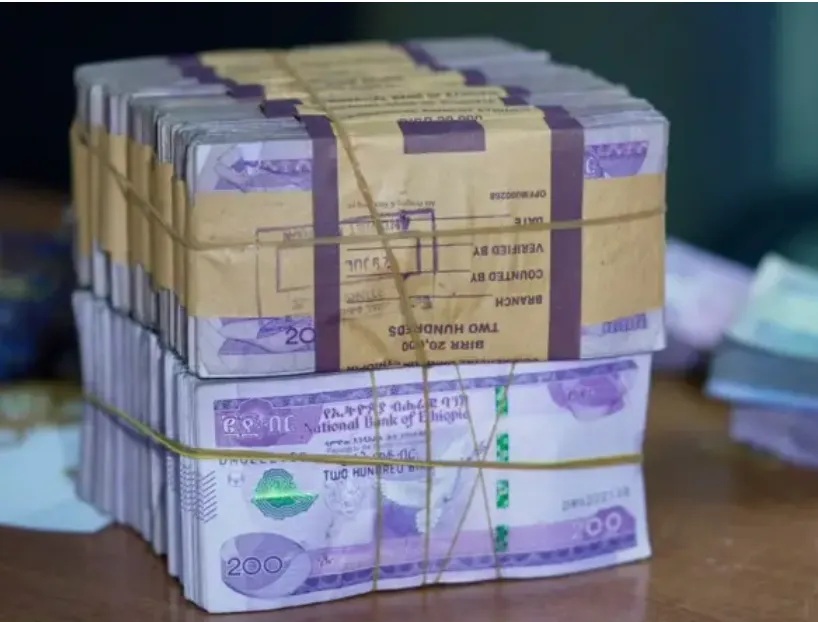
The Ethiopian Birr (ETB) has fallen to a record low against major international currencies, fuelling fears among citizens, businesses, and economists as inflation accelerates and the cost of living soars.
According to the latest rate from the Commercial Bank of Ethiopia, one U.S. dollar is now being sold for approximately 152 ETB, compared with less than 60 ETB in early 2024.
Economists warned that the rapid depreciation of the Birr has amplified inflationary pressures, eroding the purchasing capability of ordinary Ethiopians and making essential goods increasingly unaffordable.
“The devaluation of the Birr reflects deep structural problems in the economy,” said a local economic analyst. “With imports essential for almost every local business, a weakening currency means higher prices across the board.”
Currency Devaluation and Its Ripple Effects
The Birr’s steep fall is part of a broader reform launched in mid-2024, when the government officially allowed the exchange rate to float more freely in response to severe foreign-exchange shortages and pressure from international financial institutions. The decision triggered an immediate drop of around 30% in the Birr’s value.
Imported goods — including fuel, foodstuffs, medicines, and construction materials — have seen steep price increases as their Birr price rises with the currency’s fall.
At the same time, prolonged internal conflict and the government’s increased spending on military equipment have worsened the fiscal situation.
Large portions of national revenue and foreign reserves are being diverted to fund security operations, leaving inadequate for essential imports or development programs.
Economists also warn that the parallel (black) market for foreign currency is exacerbating the situation.
The rate at which dollars and other hard currencies are exchanged informally is far higher than the official rate, pushing the cost of imported goods even higher and encouraging speculative trading.
“The black-market premium on foreign currency is a hidden tax on consumers,” noted an Addis Ababa–based economist.
“It further drives inflation and creates uncertainty for businesses trying to plan ahead.”
Experts Weigh In
Multiple economists warn the speed and scale of the depreciation carry serious risks.
Steve H. Hanke, director of the Troubled Currencies Project, described Ethiopia as a “prime example of currency collapse,” citing political mismanagement, rapidly declining foreign reserves, and distortions caused by the black market.
In a recent analysis, experts noted that the gap between the official and parallel-market rates had exceeded more than 50%, signalling severe distortion in the foreign-exchange system.
“The lesson is clear — do the necessary reforms and preparations before undertaking a major devaluation,” warned Zemedeneh Negatu, CEO of CBE Capital.
“The depreciation of the Birr leads to higher costs for imports, raising the overall price level. Without proper economic cushioning, it places a substantial burden on the cost of living,” added another local expert.
Dr. Alemayehu Geda, a professor of economics at Addis Ababa University, emphasized that without addressing the root causes — such as the widening fiscal deficit, low export productivity, and rampant black-market trading — the devaluation will only intensify inflation.
“Ethiopia’s economy is still largely import-dependent,” Dr. Alemayehu said.
“If you devalue the currency without boosting production and exports, and without controlling black-market trading, imports become even more expensive and inflation worsens.”
Similarly, Dr. Vera Songwe, former Executive Secretary of the UN Economic Commission for Africa, said Ethiopia’s challenge goes beyond currency management.
“Macroeconomic stability requires peace, credible institutions, and export diversification,” she noted. “Without stability, investor confidence, and control of parallel markets, no exchange-rate reform can succeed.”
Inflation Soars Amid Economic Strain
Inflation in Ethiopia has remained persistently high, with food and transport costs — heavily dependent on imported inputs and fuel — rising the fastest. Many households find their incomes can no longer cover the same goods and services they bought just months earlier.
Businesses reliant on imported raw materials are being forced to raise prices.
Some smaller firms say they are already facing cost pressures they cannot absorb or pass on fully, threatening layoffs or closures.
Public Anxiety and Social Impact
The continuous slide of the Birr has become a daily concern for urban and rural households alike. Social media and local forums increasingly reflect frustration and anxiety.
“When our money loses value, everything else loses meaning. Our savings are worthless, our income cannot cover food and rent anymore,” tweeted one Ethiopian resident.
Analysts warn that unchecked inflation, wage stagnation, and economic inequality may lead to worsened social and political instability, especially among low-income and vulnerable groups.
Government Response and Outlook
The government says it is closely monitoring developments and working with the National Bank of Ethiopia to maintain macroeconomic stability.
Officials argue that the devaluation is part of a longer-term reform effort aimed at improving competitiveness and attracting foreign investment.
This is the third change in leadership at the National Bank of Ethiopia under Prime Minister Abiy Ahmed.
The previous two governors resigned under unclear circumstances, raising concerns about political pressure and governance.
The first, Yinager Dessie, publicly warned that the country’s foreign reserves were “beyond worrying,” only days after he and Dr. Abiy had assured the public on national television that reserves were sufficient to prevent unrest.
Critics argue that reforms alone will not be enough without peace, fiscal discipline, and measures to curb black-market activity.
As long as conflict persists and resources are diverted to military spending, economic stabilization will remain a challenge.
Looking Ahead
As Ethiopia navigates this turbulent period, uncertainty looms large.
The recent depreciation may help align exchange rates, close the gap with the parallel market, and attract investors. But in the short term, it has already deepened inflation and widened economic hardship for many.
For Ethiopia, the challenge is not only economic but humanitarian — managing necessary reforms while mitigating the human cost of rising prices, conflict, and instability.
The Birr’s continuing slide is more than a numbers game; it reflects the fragile balance between implementing structural change, curbing black-market distortions, and safeguarding the livelihoods of millions.